Liquid Cooling Insights
What Are the Best Coolants for Data Center Liquid Cooling?
By Joe Sullivan, Product Development Manager, Mikros Technologies
December 9, 2025
Hyperscale data centers are contending with an unprecedented surge in heat output, driven by powerful AI chips and increasingly dense workloads. Liquid cooling has been an effective thermal management solution for multiple generations of computing. Still, the step-change shift from legacy enterprise workloads to high-density GPU deployment has increased the performance stakes while raising critical questions.
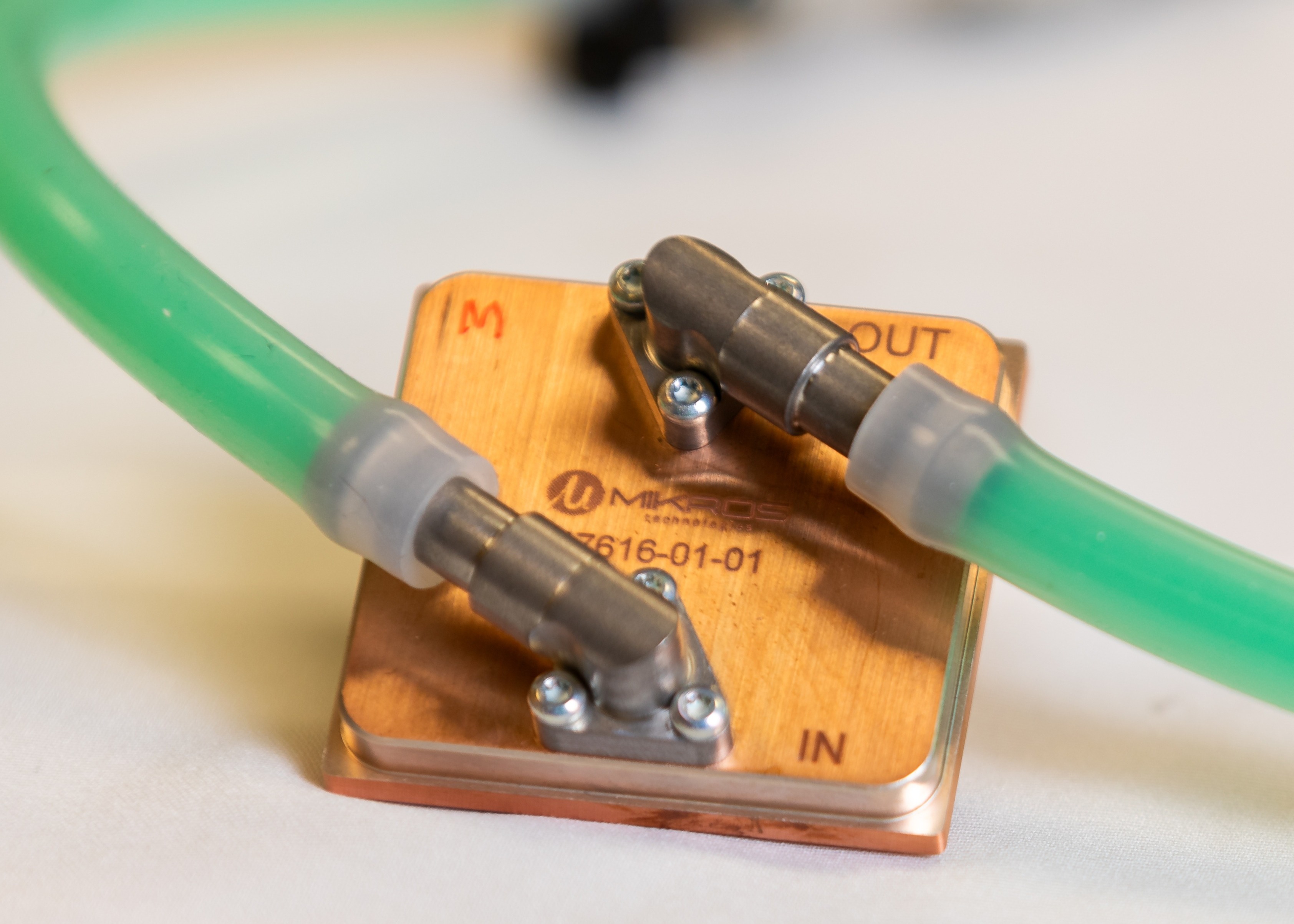
At Mikros Technologies, we often get asked: What are the best coolants for data center liquid cooling systems?
The short answer: It depends on your application. Whether you're using water, glycol, dielectric fluids, or new formulations just entering the market, the properties of the coolant will directly impact system performance, cost, and long-term reliability.
Here's what you need to know:
Coolant 101: Why Fluid Selection Matters
The job of a coolant is simple — carry heat away from sensitive electronics. But the performance of that task hinges on multiple physical properties:
-
Specific heat capacity – how much heat the fluid can absorb per unit of mass
-
Thermal conductivity – how efficiently it moves heat within the fluid
-
Viscosity – how easily it flows through tight microchannels and plumbing
-
Electrical conductivity – whether it poses a risk in the event of a leak
-
Freezing/boiling point – which affects performance and maintenance windows
When designing high-efficiency cold plates and thermal loops, Mikros Technologies’ engineers tailor the heat exchanger geometry to the coolant’s behavior. Every element — channel width, manifold design, flow rate — depends on understanding and optimizing these variables.
Water: The Gold Standard for Heat Transfer
From a thermodynamics perspective, water is the best coolant you can use. It has a high specific heat capacity, excellent thermal conductivity, and low viscosity, which makes it highly efficient at absorbing and transporting heat — even in tight enclosures and dense chip packaging.
When systems permit it, Mikros Technologies recommends using water for cold plate cooling loops. It's cost-effective, readily available, and has well-known performance characteristics. But there’s a catch: pure water doesn’t play well with metals. Corrosion, scaling, biological growth, and freezing risks require that water systems be carefully conditioned with additives and maintained under strict monitoring and controls.
Glycol Mixtures: Water Plus Practicality
To address the real-world challenges of using water, many customers deploy aqueous glycol mixtures, such as:
-
Ethylene glycol (EG)
-
Propylene glycol (PG)
These are typically mixed with water in concentrations ranging from 20% to 70%, depending on the temperature requirements, and also have algaecide and corrosion inhibitors. Glycol protects against freezing, making it particularly valuable in colder climates, outdoor enclosures, or for freeze-protection during shipping.
However, the tradeoff is performance. Glycol has a lower specific heat, lower thermal conductivity, and a higher viscosity than pure water, which means coolant loops must be adjusted through larger flow channels, require more pumping power, or have an increased surface area in the heat exchanger. Mikros Technologies accounts for these design changes by optimizing cold plate geometry for the specific glycol blend used in your system.
Dielectric Fluids: Safe but Less Efficient
For sensitive electronics environments, non-conductive coolants are preferred; this is where dielectric fluids come in. Dielectrics are mainly used in semiconductor test environments, where equipment is in constant motion and leaks or spills are more common. The main types of dielectric coolants include:
-
Fluorinated fluids
-
Synthetic hydrocarbons
-
Silicone-based oils
Dielectric coolants offer peace of mind: They won’t short out a board if there’s a leak. They're ideal for both single-phase and two-phase immersion systems, as well as for cooling power electronics, RF components, or telecom infrastructure. However, they come with tradeoffs:
-
Lower thermal conductivity than water
-
Lower specific heat
-
Higher cost
-
Environmental and disposal considerations (for some formulations)
Mikros Technologies’ cold plates can be customized to accommodate these fluids, with flow patterns and internal geometries that minimize pressure drop and maximize heat dissipation, even in single-phase dielectric cooling loops.
Emerging Coolants: What's Next?
The data center industry is also exploring next-gen coolant formulations designed specifically for increased performance, reliability, and efficiency. Some promising directions include:
-
Bio-based coolants that reduce environmental impact
-
Refrigerants in two-phase loops
As new coolants enter the market, Mikros Technology partners closely with OEMs, integrators, and hyperscale operators to test compatibility and optimize cold plate performance accordingly. The goal is to provide designers with more thermal budget headroom, freeing them to increase power density without compromising performance or longevity.
So, What’s the Best Coolant?
There is no one-size-fits-all answer. Here’s a quick breakdown of coolant selection by priority:
|
Need |
Recommended Coolant |
|
Maximum heat transfer |
Deionized water (with additives) |
|
Freeze protection & corrosion |
Water-glycol mix (with additives) |
|
Electrical insulation |
Dielectric fluid |
|
System safety & moderate cooling |
Synthetic oils or fluorinated fluids |
|
Sustainability or innovation |
New bio-based |
At Mikros Technologies, we don’t dictate the fluid; we design to it. Customers come to us with their coolant requirements, and we develop precision-engineered cold plates to match. We model heat flux, flow rates, and material compatibility to ensure peak thermal performance with minimal pressure drop, regardless of the medium.
Final Word: It’s Not Just the Fluid. It’s the System.
Choosing the right coolant is a strategic decision. However, coolant selection only delivers results when paired with an innovative mechanical design, which is where partnering with Mikros Technologies really makes a difference.
Whether you're cooling high-performance ASICs, networking gear, memory modules, or power delivery systems, we help you:
-
Optimize flow paths for the selected fluid.
-
Maximize thermal contact and heat transfer.
-
Extend the lifespan of your equipment.
-
Enable tighter packaging without sacrificing performance.
From water loops to immersion to dielectric-cooled VRMs, Mikros Technologies has helped solve thermal challenges across some of the most demanding data center environments in the world.
Let’s Talk About Your Coolant Strategy
If you're evaluating liquid cooling for your next-generation system, or wondering whether your coolant is holding you back, we're here to help. Mikros Technologies can collaborate with your team to develop thermal solutions tailored to your application, coolant, and performance goals.
About the Author:
Joe Sullivan is Product Development Manager at Mikros Technologies, leading cross functional teams from requirements scoping through pilot production to deliver advanced liquid cooling solutions for high performance computing, AI, and semiconductor test customers. Joe holds a PhD in Mechanical Engineering from MIT, an MS in Civil & Environmental Engineering (Atmosphere/Energy) from Stanford, and a BS in mechanical engineering from Cornell University.
Discover how customizable our liquid cooling solutions are.
We work directly with your team to drive your business success.
You can find answers to many of our frequently asked questions.